The Glory of the Lord
 Gramps49
Shipmate
Gramps49
Shipmate
in Kerygmania
Luke 2:8-20
I was going to do a Biblical Review of this story, but I got to wondering, could the Glory of the Lord actually be a description of the Aurora Borealis, the Northern Lights? Unfortunately, there is no known record of unusual sun spots during that time, though the first recording was around 800 BCE in China--the problem being there was no way of measuring sun activities during Jesus' time.
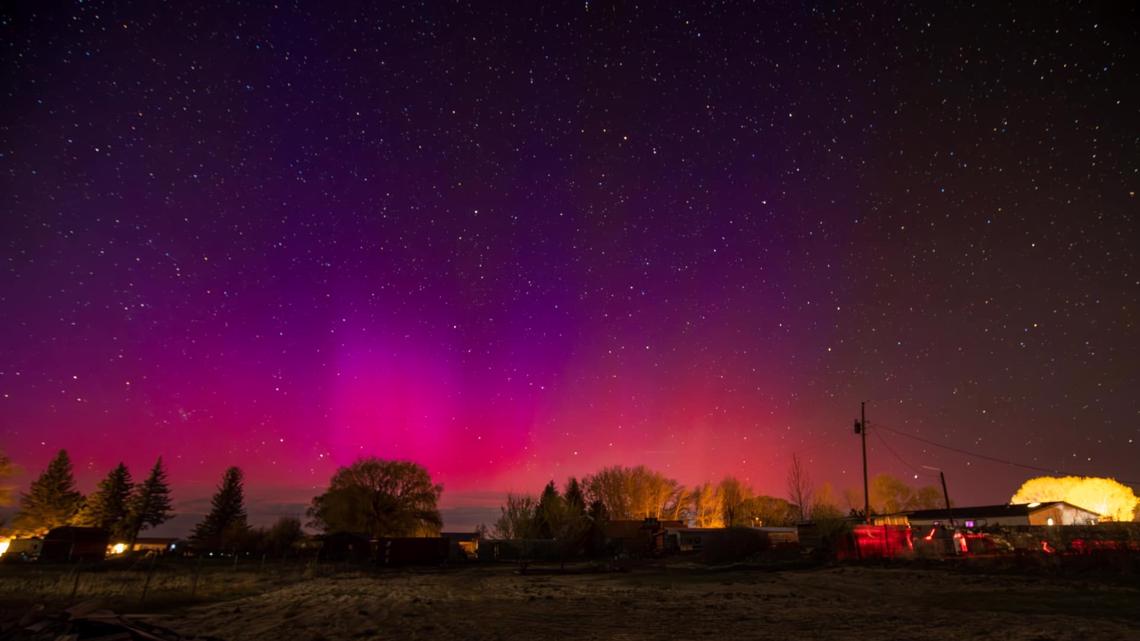
That said, there are documented sightings as far south as Cuba, Hawaii and Singapore. The latitude of Bethlehem is around 31 degrees, Cuba is at 21 degrees, Hawaii 19 degrees and Singapore is 2 degrees. I know recent Borealis maps have shown the strongest ones could be seen in Pheonix AZ Here is an image of the lights outside of Wickenberg, about the same latitude as Pheonix ~33 degrees.
Just checked the 11 year cycle for Sunspots, though. There would have been 184.45 cycles since now and then. A little off.
What I have been doing while recuperating from the gallstones.
I was going to do a Biblical Review of this story, but I got to wondering, could the Glory of the Lord actually be a description of the Aurora Borealis, the Northern Lights? Unfortunately, there is no known record of unusual sun spots during that time, though the first recording was around 800 BCE in China--the problem being there was no way of measuring sun activities during Jesus' time.
That said, there are documented sightings as far south as Cuba, Hawaii and Singapore. The latitude of Bethlehem is around 31 degrees, Cuba is at 21 degrees, Hawaii 19 degrees and Singapore is 2 degrees. I know recent Borealis maps have shown the strongest ones could be seen in Pheonix AZ Here is an image of the lights outside of Wickenberg, about the same latitude as Pheonix ~33 degrees.
Just checked the 11 year cycle for Sunspots, though. There would have been 184.45 cycles since now and then. A little off.
What I have been doing while recuperating from the gallstones.
Comments
Remember at the time of Jesus, most night skies would be much darker than they are now. As I showed in the image from AZ, the colors of the Aurora were quite vivid in spite of the lights on the ground.
To the point, it does not relate to literal physical events:
It might not be, but the Aurora Borealis probably comes close to what Luke had in mind when he wrote the account, IMHO.
Personally, I would think what Luke (and John in the prologue to his Gospel—“and we beheld his glory”) had in mind was the OT idea of kavod, which was, I think, less about anything they saw in the sky and more about immediate awareness of God’s majesty, connected to God’s presence in their midst.
At 31degrees N, the Borealis would have indeed been a rare sight. How else would you think it could be interpreted at that latitude at that time? Cecille B Deville, where are you?
So again, what leads you to the opinion that the Aurora Borealis probably comes close to what Luke had in mind when he wrote his account? What in the text suggests to you something like the Aurora Borealis rather than, say, something like a meteor shower or some other phenomenon, or something not confined to the sky, or even something not found in the natural world, is what Luke had in mind? I mean, he does tell us what he considered it to be—“the glory of the Lord.”
כָּבוֹד (kavod) literally denotes “weight” or “heaviness,” figuratively expressing what is weighty in a moral, social, or spiritual sense: splendour, honour, reputation, wealth, or the visible manifestation of divine presence.
📖 Where Kavod Can Mean “Armament”
Psalm 3:3 (Hebrew Bible):
“But You, O LORD, are a shield for me, my glory (kavod), and the One who lifts up my head.”
Here, kavod is connected to God’s protective power. Some commentators note that the root idea of “weight” or “heaviness” can extend to armor or battle gear — something substantial that shields and defends.
Thus, kavod is interpreted as armament or battle protection, not just abstract honor.
Semantic Root:
Kavod comes from kaved (כָּבֵד) meaning “heavy.”
In military contexts, “heaviness” can describe the weight of armor or weaponry.
So kavod can figuratively mean the heavy protection of God, akin to armament.
Other Biblical Echoes:
In passages where God’s kavod fills the temple (e.g., Exodus 40:34), the “weight” of divine presence is protective and overwhelming — like a shield.
Ancient interpreters sometimes extended this to martial imagery: God’s glory as a kind of battle armor for His people.
✨ Theological Implication
When kavod is read as armament, it shifts the meaning from abstract “glory” to tangible defense:
God’s presence is not just radiant but weighty protection.
The believer’s “glory” is not fame but the armor of divine honor.
This resonates with later imagery like Paul’s “armor of God” in Ephesians 6.
Source: https://www.bridgesforpeace.com/resource/glory-kavod
https://firmisrael.org/learn/the-weight-of-glory-and-the-hebrew-word-kavod/
What with all of the other miracles involved, I don’t see why this wouldn’t be any less literal than the others.
Just saying… why would we not balk at angels but need to find a natural explanation for the glory of the Lord?
Or any more literal.
Glory does not mean "light."
Glory means "presence."
The root of kavod is a word meaning heavy. That heaviness can be interpreted in a couple of ways:
(1) worthiness or importance, as BroJames and Nick Tamen have already noted. God and God's activity are the most important, weighty matters in the universe.
(2) palpable presence. It can be the sense of 'heaviness' as a sensory experience of the presence of another.
Your own cited sources make no mention of light, instead focusing on the solidity of the presence of God and God's will to protect.
Heat can radiate. A person's presence can be experienced as radiating. Light is not the only thing that radiates.
Points (1) and (2) are useful and helpful interpretations of those rather chewy passages in John (John 13:31,32; John 17:1, 4, 5, 22-24) about glory with reference to the impending crucifixion. Nothing about the crucifixion was bright or shiny, but it was absolutely about the most important things in the world - defeat of sin and death - and about the palpable presence of God, the Second Person, hanging on the cross.
Shepherds in the field, experiencing the palpable presence of the divine radiating around them, would have been scared shitless and rightly so. Although you may not wish to use that exact phrasing in a homily.
I respectfully disagree. When it says, "The Glory of the Lord shone around them." the implication was it was a shiny light.
Exodus 24:17 says “Now the appearance of the glory of the LORD was like a devouring fire on the top of the mountain in the sight of the people of Israel.”
Yes, it means presence, but sometimes it can be seen.
(I expect) from an anti religous point of view, a natural explanation of a light source would be nice (why that myth then) but not needed (could be made up, and not part of text)
And similarly from a religious point of view, fitting but not needed (text or miracle).
I think we agree that the presence can be experienced in different ways from a human point of view, which might include visual experience.
It's notable that hedge words instantly crop up when it comes to human experience of the presence: "sometimes" "it can". The difficulty with describing the experience of being in the presence is human sensory and cognitive limitation, further limited by trying to put it into words of whatever language we have on hand.
Your quoted verse from Exodus does this too: the appearance of the glory of the Lord was LIKE a devouring fire. The presence nearly defies description. This is comparable to Acts 2:3: divided tongues, AS OF fire, appeared among them.
The glory of the Lord in the event of the crucifixion is one place in Scripture where there are no waffle-words about the presence - the worthy, palpable presence - of God in human experience.
Speculative imagination is fun, and following one's own imagination down non-Scriptural rabbit holes can be entertaining (IME, more entertaining to myself than others).
The attempt to link aurora borealis with Luke 2 seems to me just such an exercise. If you're determined to indulge in non-Scriptural speculative imagination, why not go whole hog? Maybe what the shepherds were seeing was all the future Christmas lights in the world together at once! Maybe UFOs were blinking their lights all together to salute the newborn king! Those descriptions are equally justified as the aurora idea.
So, if we’re talking about what Luke had in mind, it appears to me that he had in mind a sense of surrounding presence and of imminence. He seems to be saying that the light, if that’s the way in which the shepherds perceived the kavod of God, surrounded the shepherds. That does not sound to me like a description of distant lights confined to the northern sky.
Not all Orthodox take these things in a baldly literal sense, Christ being lit up like a light-bulb as it were.
Some would say it was a case of 'spiritual perception' rather than physical phenomena of some kind. The disciples 'seeing' beyond physical appearance to the spiritual reality.
But as we are dealing with things divine then I don’t see we have to preclude supernatural light either.
Whatever the case and interesting as it may be, I see no reason whatsoever to speculate about specific meteorological or astronomical phenomena any more that we have to cite seismic or volcanic activity, such as the eruption on Santorini for instance, to account for the parting of the Red Sea or scirocco or wind activity for the appearance of the quails in the desert.
On a more direct note, as a non-specialist I don't understand how light could be "uncreated" without actually being a person of the Godhead.
I'm Orthodox theology the 'Uncreated Light' is the direct and perceptible radiance of the divine glory. It's not 'created light' like a sunbeam or gas flame.
It's the divine 'energies' if you like in a perceptible form.
As you may know, the Orthodox view is that God is 'unknowable' in 'essence' but we can apprehend the divine 'energies.'
The 'Uncreated Light' isn't another person of the Trinity but the radiance of the Holy and Undivided Trinity, if we can put it that way.
According to Orthodox Tradition intense ascetics such as the 'hesychasts' have been able to perceive the 'Uncreated Light.'
I'm no expert but there was a controversy between the Orthodox and RCs over this issue in the 14th century. As far as I can gather both sides have since drawn closer on the issue, but I can't cite chapter and verse for that nor which Popes and other RC authorities have come out with statements which either support the Orthodox position or suggest ways of reconciling apparent differences.
At any rate, I think the 'Uncreated Light' is far more exciting and attractive than people seeing the Aurora Borealis or some other natural phenomenon.
Besides, it's part of Holy Tradition so that settles it ... 😉
That settles what?
Or that the disciples were on drugs.
Or that the references to the 'shekinah' glory of the Lord are purely literary tropes that derive from the scriptural images of light in relation to the Deity.
'In him was light ...'
The Son as the 'image of the invisible God', the 'exact representation' - or is it radiance? - of his being.
You'll know the references.
I used the smiley in the same way as I might use 'scare-quotes', not to indicate that I don’t believe this myself. I do. But it is an acknowledgement that not everyone sees things that way.
As an Orthodox Christian I'm operating within a paradigm where scripture is part and parcel of what we call Tradition and although primary and authoritive is best understood within that context rather than outside or even alongside it.
At the same time, I am also aware, of course, that it's as easy to topple into a kind of 'church-fundamentalism' as it is into 'biblical-fundamentalism', where sources of authority become fixed and rigid and can be weaponised to beat other people over the head.
FWIW I agree with your cogent post @Leaf that if we are going to speculate about the Aurora Borealis in connection with the 'Glory of the Lord' then we might as well speculate about UFOs or some other explanation.
Of course, we might all be taking an overly literal approach here and the 'light' language could be figurative.
Or it could be a both/and thing ...
Now, I'm not saying it is wrong to speculate about 'natural' explanations for apparently miraculous events and phenomena found in scripture. There are suggestions as to what manna might have consisted of, for instance or how the quails might have been blown in large numbers into the desert.
And so on and so forth.
Which is all very interesting but I'm afraid strikes me as the phenomenological equivalent of medieval speculation about angels and heads of pins.
Now, if we are citing Big T Tradition or small t for that matter, I see no reason why such speculation shouldn't be 'allowed' as it were. Thinking aloud. Thinking allowed.
Hence the winking smiley.
I'm not saying, 'Holy Tradition says that the "glory of the Lord" is the Uncreated Light of Tabor, the Light of the Transfiguration, the radiance of God's energies, the same light that illuminated the face of St Seraphim of Sarov and other Saints and holy people @Gramps49 so this thread is a complete waste of time ...'
No.
I do believe that God works in and through natural phenomena and 'the work of human hands.' All the sacraments are physical for instance.
'Speak through the earthquake, wind and fire, / O still small voice of calm.'
Could God reveal something of his glory through the Aurora Borealis? Yes, of course he could.
Or by the particular conjunction of stars and planets?
Yes.
Or through human relationships and endeavours? Most certainly.
An RC priest once observed to me that we could understand the story of St Seraphim of Sarov's face being illumined like that of Moses and lighting up the spruce trees roundabout in a figurative sense.
But why can't we understand it as something 'supernatural' or 'supranatural'?
In the Kerygmatic issue we are dealing with, why can't the 'Glory of the Lord' be a literary device and an attempt to capture the numinous and inexpressible at one and the same time?
How do we understand the Transfiguration? Christ lighting up like a light-bulb? Or the disciples seeing beyond the immediate and the 'natural' to see things as they actually are, Christ as the 'image of the invisible God, the exact representation of his being'?
To the extent that @Gramps49 is taking a non-dualistic approach and seeing God's 'immanence' expressed through natural as well as apparently 'supernatural' or 'supranatural' phenomena then great, I agree with him.
But at the same time I think it rather reductionist to speculate whether it was the Aurora Borealis or light refracted off a shiny surface or whatever other explanation we might come up with - such as UFOs or whatever else.
It rather misses the point, I think.
And we can come to that conclusion by both Big T and small t directions.
I'm happy to go with what the Orthodox call Holy Tradition on this one, not to be party-spirited or awkward, but because I believe it makes sense - so far as we can - of the scriptural data on the 'Glory of the Lord' as manifested to shepherds, disciples and ordinary human beings.
And yes, why can't that same 'glory' be apprehended by Saints and saints - both Big S and small s - within both 'Eastern' and 'Western' forms of Christianity down the ages and beyond the boundaries of the Christian faith itself if God so wishes.
'God is the Lord who has been revealed to us. Blessed is he/she/them that cometh in the name of the Lord.'
The ancients got it right; we moderns got it wrong. Why do I see C.S Lewis shaking his head again?
So what you are saying is that light isn't light ...?
It's heavy instead.
Who knew?
As this is Kerymania does anyone feel it's time to extend things out to an examination of the 'light' imagery in the scriptures?
There's the reference to the 'eternal weight of glory' (depending on translation of course) and the Greek scholars here would be able to explain what that signifies in the original Greek.
Plus all the light and darkness imagery in the Gospels.
As the allusion I made was to a NT verse, though, I'm interested as to whether the Greek maintains the sense that Leaf and others highlight from the Hebrew scriptures.
I recognise that the concept of 'glory' isn't all about 'light' but there's a lot of scriptural imagery which is and which arguably ties in with it.
However we understand these things though, I'm pretty sure it has little to do with observations of natural phenomena such as the Aurora Borealis.
Of course the biblical authors draw analogies from the natural world and their world-view was one in which comets and heavenly-bodies were seen as portents etc but I don't think they saw the Aurora Borealis one evening and thought, 'Aha! Let's write about that in the next exciting installment of the holy scriptures ...'
As I said above, I suspect Luke and John had the Hebrew concept of kavod in mind when they wrote of what we call “the glory of the Lord,” and it appears that doxa was indeed the Greek word used to translate kavod in the Septuagint. From the Wikipedia article on “doxa,”: (That article goes on to describe the continuing development of doxa to lead to words like orthodox and heterodox.)
So it seems that while the Greek doxa may not originally have had the “weighty” meaning of the Hebrew kavod, it may have taken on something of that meaning, at least in the understanding of Greek-speaking Jews and the NT writers, because of the underlying Hebrew understanding.
It also appears that the Greek doxa has no particular connotations of “light.”
Not quite, I am saying light can be heavy, not that it always is. A feather is light, a ton of feathers is not! The continual force you have to exert to resist the gravitational force on the mass of feathers makes a ton of them heavy.
It seems I was off on a tangent with the 'light' issue.
Although a Kerymania thread on 'light' motifs in the scriptures would be interesting.
I should have thought of the doxa connection with orthodoxy and heterodoxy as I knew that the former can be translated as 'right-worship' or 'right-glory'.
Which would make sense if we are talking about 'presence' - as we are meant to come into the presence of God in worship of course and some Christians believe in the 'real presence' in the eucharist of course, however that is understood.
I thought you were bang on. English has the oddity of light (noun) meaning "brightness" and light (adjective) meaning "not heavy." I do not know whether any of the antecedent languages have the same thing going on, but it does make things interesting here.
Doxa brings new questions, for me. I wonder how the connotations of kavod in terms of "weighty matters of importance" has implications for understanding doxa as "praise" or "worship."
We might start from the following proposition: There can be no matter of weightier importance than God, worshipping that God 'correctly,' and connected with that experience of worship, understanding who God is and what God wants.
However we understand the terms, it seems to me that Christ was (and is) entirely concerned with ortho-praxy in line with the Prophets, both 'major' and 'minor'.
There's nothing 'minor' of course about the verse you cite and we really ought to 'major' on it ... and similar exhortations.
Yes, we should be concerned with 'right-doxy' too, by which I don't mean we should get all reductionist about the 'correct' way to light a candle or venerate an icon or do this, that or the other thing we might do within our respective traditions and churches.
Ideally, of course, the two should go hand in hand and getting that right is easier said than done.
Lord have mercy!
As if particular practices in church services are on a par with the Nicene Creed.